



Fuerteventura’s 5 best beaches for riding the waves
12 June 2025
How many lessons does it take to learn kitesurfing? Let’s clarify
12 June 2025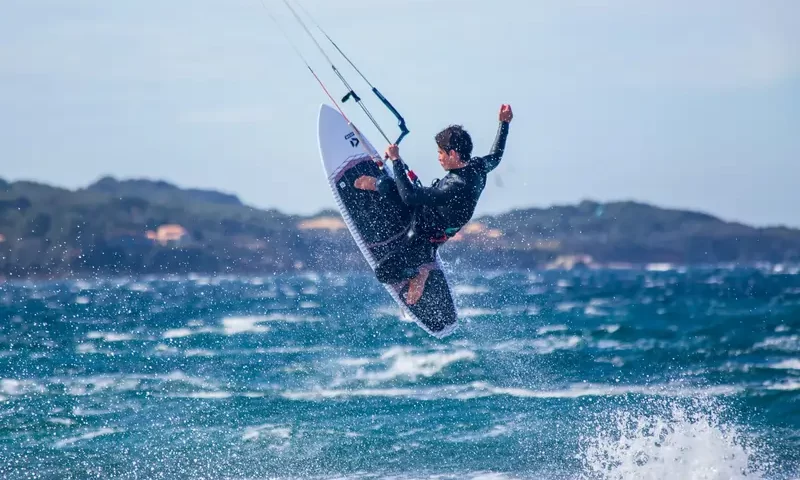
Jumping is the essence of kitesurfing, but learning the technique takes practice, tenacity and a good instructor
“Spectacle” is the middle name for kitesurfing: doing evolutions on waves while dominating the wind with a kite is what characterizes this sport that mixes surfing, paragliding and windsurfing.
Before we get to the evolutions, however, we need to learn the basic techniques, among which we find jumping.
The question comes naturally: how do you learn to jump? Let’s delve into this topic together and see what needs to be done for good kite jumping.
Kitesurfing jumping: the basics
Learning to jump with kitesurfing is one of the most complicated yet exciting moments for the beginner kiter. In kiting, jumping is equivalent to shooting at a goal for a soccer player: it is a fundamental technique that depends yes on the strength of the wind, but also on a combination of carefully executed movements.
Before attempting the jump, it is critical to understand how to control the kite and board. The starting position is for the kiter to stand sideways, with the body leaning back slightly and the knees just bent to maintain balance and responsiveness. Controlling the kite allows you to decide the angle and power of the kite, which will determine the height and duration of the jump.
The“pop” is a key element in the jumping process. This technique uses the tension of the board against the water to generate upward thrust. To execute it correctly, the kiter must push his or her heels into the board with a good amount of force: at the same time, he or she must pull the kite upward at the point of maximum power. The timing of the push and the intensity with which the pop is performed are critical to the quality of the jump.
These are the basic principles of effective kitesurfing jumping, which as we have seen include precise control of the kite, good balance on the board, and equally timely pop timing.
Read also: 4 tips if you are thinking of learning kitesurfing
Kitesurfing: all phases of jumping
Effective jumping, in kitesurfing, requires skill and practice.Before embarking on attempts, however, it is important to assimilate precise technical principles, broken down into several stages.
The first phase begins with full control of the board, which as already mentioned must be kept shear in the water, using the momentum exerted by the heels. This is a key step in making the take-off.
Immediately after that, it becomes important to properly control the kite, keeping the bar in the optimal position to make the most of its power. Managing speed and the forces involved is achieved through proper leg posture and thrust.
The jump preparation phase therefore requires the body position to counteract the pulling force of the kite: the shoulders should be oriented backward and the heels pressed against the board. When the kite reaches the point of maximum pull, the kiter surrenders to its strength to begin the ascent.
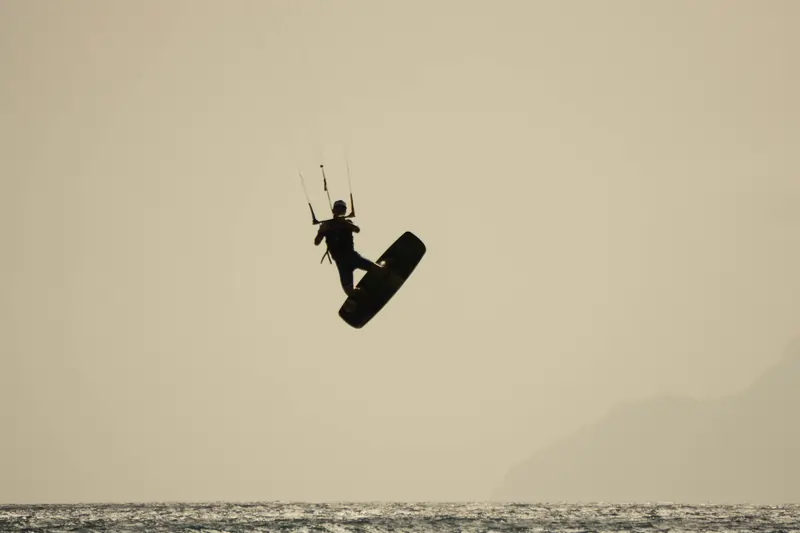
During the aerial phase, the kiter must know how to manage the kite and his or her own position to maintain balance and prepare for landing: proper bar placement and timing in pulling the kite back toward the direction of travel are critical.
Landing requires that you bring the kite back into gait and direct the bow of the board in the direction of the wind to accommodate the downwind buoyancy.
These are the principles, and techniques, to be learned if the desire is to kite jump effectively and safely. Each step has its own importance and must be performed carefully to ensure successful jumping and kiter safety.
As you can guess, it is difficult without a good instructor to learn how to jump properly. That is why taking kitesurfing courses is the best choice to learn the technique cleanly and avoid the risks that a maneuver like jumping can cause.
Jumping with kitesurfing: mistakes to avoid
Kite jumping can be a source of numerous mistakes, especially for beginners.
One of the most common mistakes is not correctly assessing the strength and direction of the wind, which can lead to jumps that are too short or, conversely, jumps that are too long and difficult to control, increasing the risk of dangerous falls.
Another frequent mistake is failure to control the sail during the jump. Many kitesurfers tend to focus only on their position and the board, neglecting the importance of maintaining constant tension on the sail lines-this can result in losing lift or executing an unpredictable jump trajectory.
Finally, landing, which if done clumsily can lead to injury, especially if the kitesurfer does not properly absorb the impact with the knees or if the board is not aligned with the wind direction.
The key to avoiding these mistakes? Good preparation and lots of practice under the supervision of a qualified instructor.
Read also: How much wind does it take to kitesurf? Here’s why this parameter is so important
In conclusion
Kitesurfing jumping is an exciting time for beginners, but it hides no small pitfalls. To perform an effective and safe jump, mastering techniques such as kite and board control is essential. Each step of jumping, from preparation to landing, requires attention and practice to ensure safety and success.
By the way, if you want to learn kite jumping and all the other techniques, you can sign up for our kitesurfing courses in Fuerteventura, where trained and qualified teachers will lead you to discover this fascinating sport… and jumping will be just the first of many spectacular evolutions!
Takeaways
- Jumping is a pivotal moment: in kitesurfing, jumping represents a crucial technique that requires not only the strength of the wind, but also a precise combination of carefully executed movements to gain height and control during ascent and landing;
- Jumping phases: kitesurfing jumping requires following several phases, which include board and kite control, jump preparation, ascent and landing. Each of these phases requires skill and practice to be performed correctly:
- Common mistakes to avoid: Common mistakes in kitesurfing jumping include misjudging the wind, not controlling the sail during the jump, and landing awkwardly. Avoiding these mistakes requires good preparation and lots of practice, preferably under the guidance of a qualified instructor;
- Importance of the instructor: a good instructor is essential to properly learn kitesurfing jumping techniques safely and effectively. Taking kitesurfing courses with qualified instructors can help you avoid risks and make faster progress in the sport;
- Practice and perseverance: mastering kitesurfing jumping requires practice, tenacity and a good dose of perseverance. Each phase of jumping must be approached with focus and dedication to ensure success and safety while performing spectacular evolutions over waves and wind.
Frequently asked questions
How do you learn to jump with kitesurfing?
Learning to kitesurf jump requires mastering several techniques. First, it is essential to understand kite and board control. It starts by keeping the kite in an optimal position to harness its power, while the board must be kept shear in the water. The “pop,” or upward thrust, is essential for jumping and is achieved by pushing your heels hard on the board and pulling the kite upward at the same time. These are just some of the steps and techniques needed to learn how to kitesurf jump.
What are the stages of kitesurfing jumping?
Kitesurfing jumping is divided into several stages. First, there is the control of the board, maintaining its shear position in the water. Next, it is important to properly control the kite, keeping the bar in the optimal position to harness its power. The preparation phase for jumping requires a body position contrary to the pulling force of the kite. During the ascent, the kiter must manage the kite and his or her position to maintain balance. Finally, landing requires restoring the kite to gait and aligning the board with the wind direction.
What are the mistakes to avoid in kitesurfing jumping?
In kitesurfing jumps, it is important to avoid some common mistakes. One of these is misjudging the wind, which can lead to jumps that are too short or too long and difficult to control. Another mistake is failing to control the sail during the jump, neglecting the importance of maintaining constant tension on the sail lines. Finally, a clumsy landing can lead to injury, especially if you do not properly absorb the impact with your knees or if the board is not aligned with the wind direction.