


Where to surf in Europe: the best locations for “board” lovers
12 June 2025
The 7 most common mistakes for those new to surfing
12 June 2025
Learning the take-off is crucial to learning to surf: it takes time, practice and the help of a good instructor
If you are here, it means you have decided to ride the waves and learn the art of surfing. But before you surf, you need to learn how to get up on the board-don‘t worry if you’re a novice, because today we’re going to walk you through the basic steps to learn the so-called take-off.
Read also: Where and how did surfing originate? All about the history of the “board” for riding waves
Learning to stand up on the board: how to do it? The step by step guide
First of all, you must have the necessary surfing equipment, which is basically this:
- Surfboard suitable for your skill level
- Leash (elastic rope) to secure the board to your foot
- Wetsuit if the water is cold
- Wax to increase traction on the board
Having procured the equipment, you need to choose the right spot: best to favor a beach with smaller waves and a low tide bar to facilitate your first experience.
Now the actual practice can begin with the take-off, the basic surfing technique, a crucial moment that marks the first acquaintance with the board: surf schools begin with this maneuver, because knowing how to ride the wave depends directly on the ability to execute a flawless take-off.
First, you will need to lie on the board with your chest up and your hands placed at the sides of your shoulders, keeping your feet aligned with the back of the board and looking for a central balance point.
Now use your hands to paddle steadily and firmly. Try to move through the waves without overexerting yourself. Keep your head up and your body in line with the board.
When you feel the wave coming up behind you, start paddling more vigorously to gain speed. Your board should be leaning slightly toward the wave, while your gaze should be over your shoulder.
Now comes the time to stand up on the board! When you feel the wave is pushing you, place your hands near your shoulders and push yourself upward hard. Quickly bring your feet under you, position them stably, and try to stand up on the board.
Mind you, this is not a technique that can be learned quickly. You must cultivate the art of patience and not become discouraged at the first difficulties. In addition, you have to consider variables such as wave direction and perfect timing. As an example, beginners focus on pushing the foam to maintain balance and move straight forward on the board: certainly an important step, but not enough to turn a beginner into a surfer.
There are different methodologies for teaching the take-off: some schools teach the maneuver in several stages, first resting one foot and then the other, others to perform the technique in one fluid movement.
Timing is the key to success in learning this technique. Arriving on time to rendezvous with the wave is the secret of surfing, and the same goes for the take-off, which becomes a natural maneuver only with a lot of time and hundreds of attempts.Acquiring awareness of the ideal timing, as mentioned, is a matter of patience.
These aspects-timing and take-off-present the greatest challenge for those who dream of becoming an expert surfer. Only through experience and dedication can the surfer hope to ride the waves with mastery.
What happens after standing on the board?
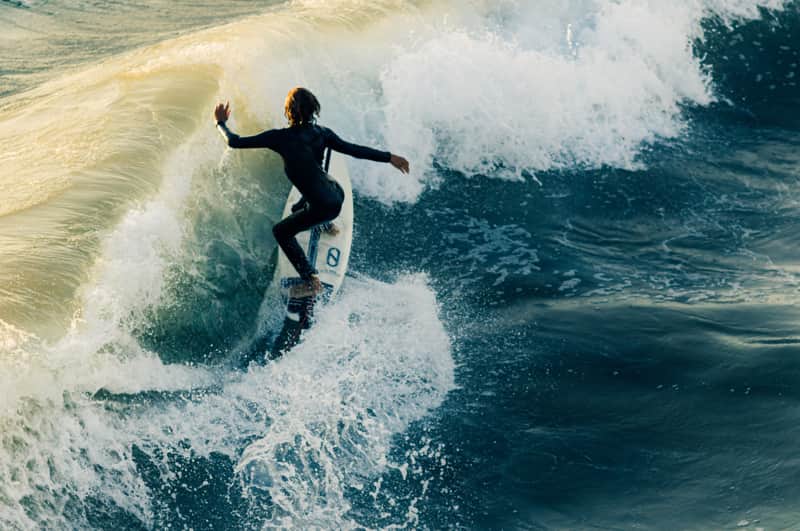
After learning how to get on your feet, perhaps by helping yourself to the foam buoyancy, it is time to tackle the wave, which must be cut on its wall before it breaks. This is already a more complicated step, even taking into account the sea conditions.
What is important is to avoid learning this very delicate practice sloppily: learning the technique wrongly can undermine the learning of surfing, with mistakes difficult to overcome over time.
Why learn take-off at a surf school
The “take off” is one of the most rewarding moments in surfing, but it can also be one of the most difficult to master. That’s why relying on a competent instructor is a choice that will pay you back handsomely in tuition costs.
A good instructor has enough experience and knowledge of basic techniques to help the studentquickly understand how to position the body, distribute weight, and maintain balance optimally. In addition, he or she can give immediate feedback and correct imperfections right away, which will greatly accelerate your learning.
An experienced instructor can create a personalized learning plan for you so that you progress step by step, encouraging you to overcome difficulties and persevere.
Finally, a surf instructor is well versed in local conditions and the best beginner spots, and will have you practice in safe locations appropriate to your skill level.
Read also: The 7 most common mistakes for those new to surfing
In conclusion
The take-off is a basic surfing technique that must be learned early in the practice of this fascinating sport. Learning how to stand on the board, get upright and maintain balance, is far from easy: it takes patience, perseverance and practice. A trained instructor, perhaps within an ideal environment for this activity (ideally a good surf school in Fuerteventura) will know how to lead you, step by step, to learn this fundamental technique.
Takeaways
- Before you start your surfing adventure, make sure you have the right equipment, which includes a board suitable for your skill level, a leash to secure the board to your foot, a wetsuit if the water is cold, and wax to improve traction on the board.
- To make your first surfing experience easier, select a beach with smaller waves and a low tide bar. This spot choice can make your learning easier.
- The “take-off” represents the fundamental technique of surfing. Learning how to properly position yourself on the board, paddle and stand up takes time and patience. Timing and balance are essential.
- An experienced surf instructor is a valuable resource for learning the take-off. He or she provides immediate feedback, creates a personalized learning plan, and is familiar with local conditions and the best spots for beginners.
- Surfing is a discipline that requires dedication and constant practice. Do not be discouraged by early difficulties, as take-off is a skill that is perfected over time. Keep cultivating your patience and learn from mistakes.
Questions & Answers
How do you learn take-off in surfing?
To learn the take-off in surfing, it is essential to have the necessary equipment, choose the right beach and practice consistently. Start by lying down on the board, paddle vigorously to gain speed, and when the wave pushes you, get up quickly on the board. Timing is essential and requires patience and dedication.
What to do after being able to stand on the board?
After being able to stand on the board, it is important to tackle the wave by cutting it on its wall before it breaks. This stage is more complicated and requires the application of advanced techniques, so it is advisable to learn properly from an experienced instructor.
Why is it important to learn take-off in a surf school?
Learning the take-off in surfing can be difficult, but it is one of the most rewarding moments. Relying on a competent instructor offers many benefits, such as immediate feedback, correction of imperfections, and a personalized learning plan. Instructors know local conditions and the best beginner spots, ensuring safe and effective practice.